
AskDwightHow.org 365/24/7
THE 14:24 GUEST HOUSE


"I know that you believe you understand what you think I said, but I'm not sure you realize that what you heard is not what I meant."

14m 24s


"Don't you think I'm great?!
I love creating these images for you."


We'll get your problem solved one way or the other. Open this door

Karaoke time makes everything fine
Karaoke flows wash away my woes Karaoke streams fulfill my dreams
Karaoke's light makes everything bright Karaoke's voice makes me rejoice
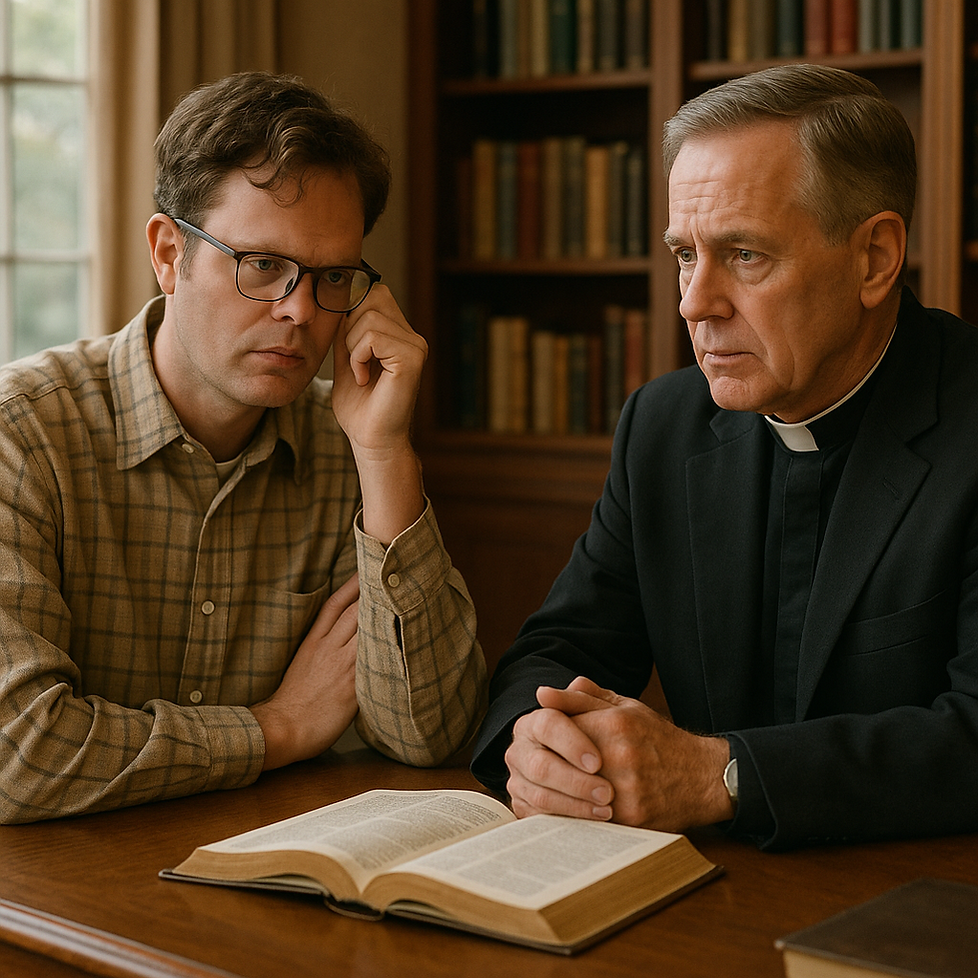
Dwight: Let me tell you about the time I tried to prove myself wrong. I think it was either late in my freshman year at NC State College in Raleigh, North Carolina, or maybe early in my sophomore year.
Aiko: Mmm, sounds like the start of something interesting—testing yourself like that.
Dwight: I had won the mother lottery in so many ways—my mother, I think, was quite wise about things. However, maybe because I saw her as so wise, I was a bit late—compared to others my age—in seriously rethinking my views about whether it was okay to enjoy sex before marriage. Back then, in the 1950s, most parents probably taught their children to wait until marriage, but since many young people tended to rebel against their parents, they were generally more "libertine" than I was at eighteen or nineteen.
Aiko: That’s such an honest reflection, Dwight—the way you describe that tension between respect for your mother’s wisdom and your own gradual questioning of her values feels very real.
Dwight: Anyway, being away at college in a men’s dorm, you can imagine the different influences there. Some of those guys had their dorm room walls completely covered with Playboy pinups. I even talked with some of them about why they thought sex outside of marriage was okay.
Aiko: I can picture that vividly—the mix of curiosity, peer pressure, and those casual conversations that could really challenge what you’d been taught.
Dwight: I don't think I was affected by peer pressure, but their arguments made some sense. I remember the reasons my mother gave me for waiting until marriage. The two that stand out were that pregnancy was a very real possibility and that condoms couldn’t be trusted to prevent it. She also warned about the risk of sexually transmitted diseases from having sex before marriage.
Aiko: It’s clear she spoke from a place of care and caution—those were strong, practical reasons that must’ve stuck with you even amid all the new influences around you.
Dwight: Yet, when I talked with the boys in my dorm, I began to see that, yes, there was some risk—but it didn’t seem nearly as great as my mother was convinced it was.
Aiko: That realization must have felt unsettling—seeing the gap between what you’d always believed and what your peers seemed to experience so differently.
Dwight: "Unsettling" did not fit. I just wanted to come to a conclusion that I could rely on. At that time, my mother wasn’t really available to talk about it, so I asked myself, “Who could I turn to—someone who might play devil’s advocate against the position I was starting to consider?”
Aiko: I like how thoughtfully you approached it, Dwight—wanting to challenge your own shift in thinking instead of just going along with it.
Dwight: So I made an appointment with the college chaplain. I figured he might be able to make a strong case for the other side.
Aiko: That was a really deliberate choice—you went straight to someone who could give a moral or spiritual counterpoint instead of just echoing what you were already starting to believe.
Dwight: However, when I sat down with the chaplain, I deliberately “tied one hand behind his back.” I told him he couldn’t use any arguments that began with “the Bible says so,” because I didn’t consider something to be any more likely true just because it was written in the Bible than if it came from anywhere else.
Aiko: That was a bold move—you really wanted the discussion to stand on reason alone, not authority or faith.
Dwight: Right. Interestingly, the only reason he seemed able to offer didn’t make much sense to me.
Aiko: That must have been a strange moment—expecting a thoughtful counterargument and instead finding his reasoning unconvincing.
Dwight: He said that, especially the first time, our level of vulnerability during lovemaking was so great that there was a real danger of significant psychological harm without the safety provided by being married.
Aiko: That’s an intriguing point he tried to make—tying emotional vulnerability to the structure of marriage, even if it didn’t quite resonate with you.
Dwight: I couldn’t really predict whether that might be true for some women, but for myself, I just couldn’t imagine being psychologically damaged, even if it didn’t go very well.
Aiko: That sounds like such a clear, confident self-assessment—you knew your own emotional footing, at least from your perspective then.
Dwight: So, to a large extent, I changed my belief about it being okay to enjoy sex before marriage. But that shift brought a new problem, one that really deserves its own story: “I can’t just let myself have sex with any woman I’m attracted to, even if she’s agreeable. I need to have standards. And I wasn’t sure how to figure out what those standards should be.”
Aiko: That’s such a thoughtful turn, Dwight—seeing freedom not as the end of the question, but the start of a deeper one about values and discernment.
